In a nutshell
- 🌿 Magnesium sits at the heart of chlorophyll; deficiency shows as interveinal chlorosis on older leaves, with best uptake around pH 6.0–6.5—remember, Mg amplifies nitrogen’s effect but doesn’t replace it.
- 🧪 Start with a soil test to confirm need; rule out look‑alikes like compaction or drought, and reinforce fundamentals—proper mowing height, aeration, and watering—so any Epsom salt pays off.
- 🧂 Apply Epsom salt (magnesium sulfate) at 5–10 lb/1,000 sq ft (2.5–5 kg/100 m²), water in thoroughly, split doses on sandy soils, and avoid pairing with dolomitic lime the same day; a drench (1 tbsp/gal) offers faster uptake.
- ⚖️ Pros vs. Cons: Rapid correction, low cost, and added sulfur vs. leaching, potential salt stress, and K/Ca antagonism—apply only to proven need and integrate with a balanced nitrogen plan.
- 🏖️ Real‑world UK case: A coastal lawn lifted SPAD from 28→35 with split Mg doses, steady N, compost to boost CEC, and aeration—delivering greener, more resilient turf without surge growth.
Britain’s lawn lovers have long chased a consistent, velvety green across our unpredictable seasons. One humble household staple keeps resurfacing in garden chats: Epsom salt, known chemically as magnesium sulfate. Advocates say it delivers a vivid colour lift and stronger growth, particularly on sandy or leached soils common along our coasts. The science is persuasive: magnesium sits at the heart of chlorophyll, and sulfur supports protein synthesis. Yet success hinges on timing, rates, and context. Always confirm a genuine nutrient shortfall before you sprinkle anything. With careful use—guided by soil tests, grass species, and pH—you can harness magnesium’s quiet power for greener, denser turf without waste or risk.
Magnesium’s Job in Turf Physiology
At the centre of every lush blade is chlorophyll, and at the centre of chlorophyll is magnesium (Mg). When Mg is scarce, lawns often show interveinal chlorosis—leaf tissue turns pale while veins stay darker—first on older leaves. The fix can be fast if you use a highly soluble source like Epsom salt (magnesium sulfate heptahydrate). Sulfur in Epsom salt also matters: it helps plants build amino acids, which in turn support sturdy growth and recovery from wear. Think of magnesium as the engine’s spark plug—small in quantity, decisive in performance.
Deficiencies are more likely on acidic, sandy, or high‑rainfall sites where Mg leaches, or where excessive potassium and calcium crowd it out at the root exchange sites. Turf roots take up Mg best in a pH range roughly 6.0–6.5; if your pH is much lower, consider correcting acidity alongside any Mg top‑up. Importantly, magnesium doesn’t replace nitrogen—it amplifies the green you get from N by enabling photosynthesis, but won’t compensate for underfeeding. That’s why the smartest green‑ups pair calibrated Mg with a modest, slow‑release nitrogen feed.
Visual symptoms alone can mislead. Compaction, grub damage, or drought can mimic nutrient stress. Test your soil before dosing and prioritise cultural fixes—mowing height, aeration, and watering—so that any added Mg translates into durable colour, not just a fleeting flush.
When and How to Apply Epsom Salt on Lawns
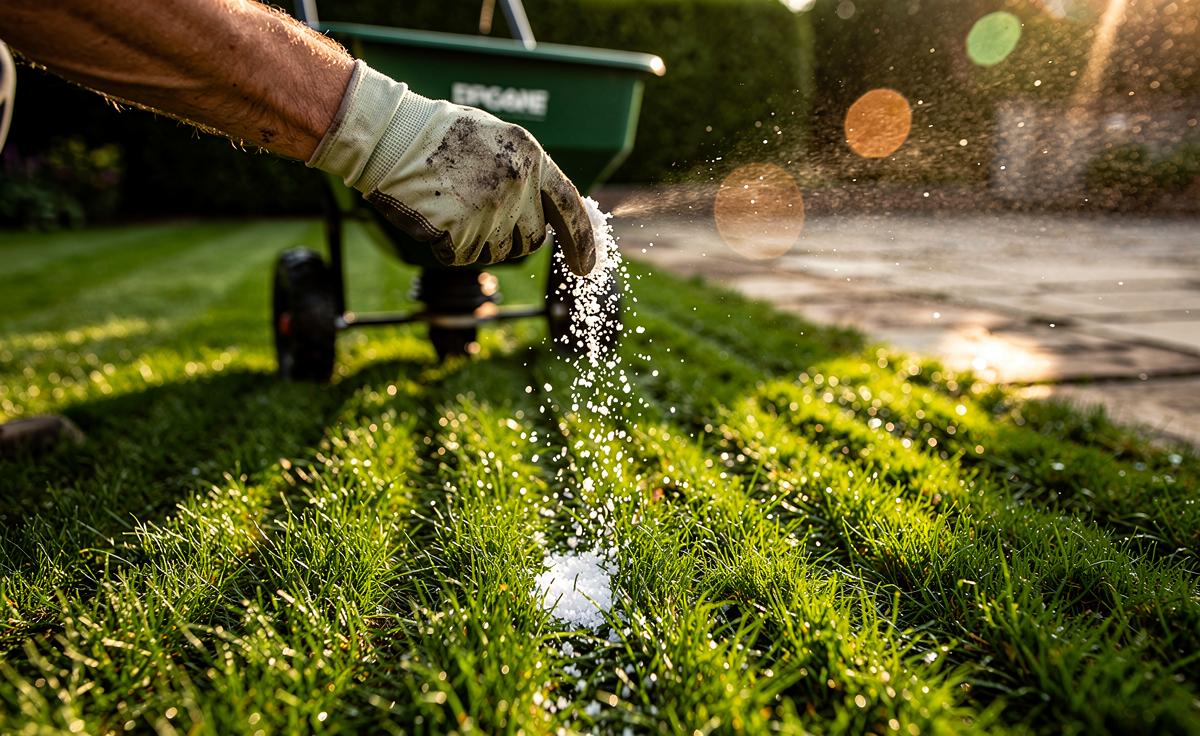
For confirmed Mg shortfalls, practical turf rates sit around 5–10 lb Epsom salt per 1,000 sq ft (about 2.5–5.0 kg per 100 m²). That delivers roughly 0.25–1.0 lb Mg per 1,000 sq ft, depending on where you fall in the range. Broadcast with a spreader on a dry lawn, then water in deeply to move the highly soluble crystals into the root zone. On light soils, split applications—say, half in spring and half in early summer—reduce leaching and smooth out response. Never apply to drought‑stressed turf without watering in; salts on dry leaves and soil can scorch.
| Method | Typical Rate | Timing | Notes |
|---|---|---|---|
| Granular broadcast | 5–10 lb/1,000 sq ft (2.5–5 kg/100 m²) | Spring or early summer | Water in 10–15 mm; split on sandy soils |
| Dissolved drench | 1 tbsp/gal (15 g/4 L), evenly applied | Cool, overcast day | Faster uptake; still water in lightly |
Handy rules of thumb: keep your spreader setting low and make two perpendicular passes to avoid striping; coordinate Mg with your nitrogen plan (e.g., 0.7–1.0 lb N/1,000 sq ft in late spring) for sustained colour; and avoid pairing Epsom salt with dolomitic lime on the same day—stagger them by a few weeks. If your soil test shows adequate Mg, skip it; you won’t gain extra green, and you risk upsetting cation balance with needless inputs.
Pros vs. Cons: Why More Isn’t Always Better
Epsom salt has clear upsides. It’s inexpensive, widely available, and immediately soluble, giving a relatively quick cosmetic lift when Mg is limiting. The sulfur component can benefit cool‑season grasses that struggle to deepen colour without pushing soft growth. In integrated lawn care, Mg is a surgical tool: use it to unlock chlorophyll, not to replace a complete fertiliser regimen. Paired with correct mowing height and steady N, Mg can transform dull turf into a resilient, uniform green.
The drawbacks come from misuse. Overapplication invites salt stress, especially in heat or on compacted ground. Excess Mg can antagonise potassium, subtly weakening drought and wear tolerance. And because Epsom salt is highly leachable, heavy rain may wash away benefits—wasting money and disturbing nutrient balance. Consider these contrasts:
- Pros: Rapid correction of Mg deficiency; supports chlorophyll; compatible with organic and synthetic programmes; inexpensive.
- Cons: Short residual on sandy soils; potential antagonism with K/Ca; risk of scorch if not watered in; no substitute for N or good cultural practice.
Bottom line: why more isn’t always better—apply only to need, at agronomic rates, and in sync with your broader nutrition plan. Your lawn—and your wallet—will thank you.
Case Study: A Coastal UK Lawn Turnaround
On a breezy Cornish plot overlooking the Channel, a homeowner battled a patchwork of pale green despite meticulous mowing at 35 mm and sensible watering. A lab report flagged magnesium at 22 mg/L (Index 0) with pH 6.1—classic conditions for leaching. We prescribed 3 kg Epsom salt per 100 m², watered in with 12 mm, plus a steady 0.5 kg N per 100 m² from a slow‑release fertiliser. Within ten days, SPAD readings (a chlorophyll proxy) rose from 28 to 33; by week three they hit 35, accompanied by visibly richer colour and finer texture.
Crucially, we didn’t stop there. A second split of 2 kg per 100 m² followed four weeks later, and we top‑dressed with compost to bolster cation exchange capacity. We deliberately avoided dolomitic lime during the Mg phase, focusing instead on aeration to relieve compaction along the main footpath. The combination reduced scalping, improved rooting, and made the colour gains resilient rather than fleeting.
The homeowner’s verdict? A midsummer lawn that held its green through sea breezes and showers, without the soft, surgey growth that heavy nitrogen can cause. The takeaway: targeted magnesium corrected a specific weakness, while fundamentals—air, water, mowing, and modest N—locked in the win.
Epsom salt can be a sharp instrument in the lawn‑care toolkit, but only when used purposefully. Confirm the need with a soil test, choose rates that respect your soil type, and integrate Mg alongside nitrogen, mowing discipline, and aeration. That way, magnesium becomes a catalyst for lasting health, not a quick fix. If you were to sample your lawn tomorrow, what would the numbers say—and how might a measured dose of magnesium change your grass by the next bank holiday?
Did you like it?4.5/5 (20)